
Snyder Mesa Fire Lawsuit Investigation
Snyder Mesa Fire Attorney: Three Firefighters Killed as Blaze Explodes Along Colorado-Utah Border
Snyder Mesa Fire Attorney Warns: Three Firefighters Killed as Blaze Explodes Along Colorado-Utah Border
Three federal firefighters died and two others suffered injuries after fast-moving wildfires overtook their crews near the Colorado-Utah border on Saturday, June 27, marking a devastating escalation in an already dangerous Western fire season.
The firefighters encountered a burnover while responding to the Knowles and Gore fires in Mesa County, Colorado. A burnover occurs when flames move around or over firefighters, cutting off their escape routes. The crew deployed emergency fire shelters, but three firefighters died. Authorities transported two injured firefighters to a hospital with burn injuries.
Officials had not publicly released the firefighters’ names as of Sunday while agencies worked to notify their families.
“Our immediate focus is on supporting their families, friends, and fellow crewmates during this incredibly difficult time,” the U.S. Wildland Fire Service said in a statement reported by FOX 13 News. “Their bravery, dedication, and sacrifice will never be forgotten.”
The tragedy occurred as several fires burning across eastern Utah and western Colorado rapidly expanded and merged. Authorities began referring to the combined incident as the Snyder Fire or Snyder-Mesa Fire.
Multiple Fires Merge Into a 28,000-Acre Inferno
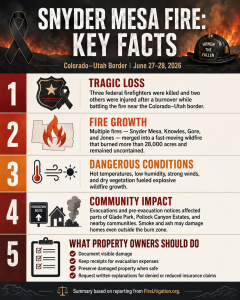 Early reports described several fire starts in the rugged region, including the Snyder Mesa, Knowles, Gore and Jones fires.
The Snyder Mesa Fire reportedly began in Utah’s Grand County before crossing into Colorado and combining with other fires burning in Mesa County.
By Sunday morning, the merged fire had burned more than 28,000 acres—approximately 44 square miles—and remained uncontained. Colorado Public Radio reported that officials attributed the initial fire activity to lightning.
The incident unfolded across remote mesas, canyons and scrubland west of Grand Junction and Fruita. Although much of the immediate fire area consists of sparsely populated public land, the fire’s rapid growth prompted expanding evacuation and pre-evacuation notices for rural communities, ranches and subdivisions.
Residents in parts of Glade Park, Pollock Canyon Estates and areas extending toward the Utah border received instructions to prepare to leave. Authorities also closed portions of the McInnis Canyons National Conservation Area.
The American Red Cross opened an emergency shelter in Grand Junction, while Mesa County facilities began accepting livestock and other animals displaced by the fire.
Heat, Wind and Critically Dry Vegetation Fueled Explosive Growth
The speed of the Snyder-Mesa Fire reflects the exceptionally dangerous conditions affecting much of the Western United States.
According to an Associated Press report published by Yahoo News, consecutive days of hot temperatures, low humidity and powerful winds fueled dramatic wildfire growth across Utah, Colorado, Arizona and neighboring states.
Temperatures in Grand Junction reached approximately 93 degrees on Saturday, while wind gusts reportedly approached 44 miles per hour. Forecasters warned that the combination of wind, dry vegetation and extremely low humidity could produce rapid fire growth and extreme fire behavior.
Those warnings proved tragically accurate.
A relatively small wildfire can expand within minutes when strong winds push flames through dry grass, sagebrush and brush. Wind can also carry burning embers far ahead of the main fire, creating spot fires that trap crews, cross roads and threaten homes from multiple directions.
The rugged terrain along the Colorado-Utah border further complicated the response. Canyons, mesas and limited road access can restrict escape routes and prevent engines or heavy equipment from reaching advancing flames.
The Guardian reported that wildfire activity had intensified throughout the West after days of hot, dry and windy weather. Utah faced particularly severe conditions following a record-low snowpack and its warmest winter on record.
Colorado and Utah Declare Fire Emergencies
Colorado Gov. Jared Polis declared a disaster emergency and authorized the Colorado National Guard to assist with the response. State emergency-management, homeland-security and firefighting agencies also began coordinating resources for suppression, evacuation, recovery and mitigation efforts.
“The State of Colorado mourns alongside you,” Polis said in a statement addressing the families and fellow crew members of the firefighters who died.
Utah Gov. Spencer Cox had already declared a statewide emergency because of severe wildfire conditions. Utah also imposed temporary fireworks restrictions ahead of the Fourth of July holiday as crews battled numerous fires across the state.
The Snyder-Mesa Fire developed while hundreds of firefighters were responding to other major incidents, including the Cottonwood Fire in central Utah. That fire expanded by tens of thousands of acres in a matter of days and became one of the largest active wildfires in the country.
The number and size of simultaneous fires can strain aircraft availability, firefighting personnel, emergency shelters and local government resources. Those pressures become even more serious when winds ground aircraft or make direct firefighting operations unsafe.
Smoke Can Cause Harm Far Beyond the Fire Perimeter
Even communities outside evacuation zones may experience serious effects from the Snyder-Mesa Fire.
Strong winds can carry smoke and ash across western Colorado, eastern Utah and communities located many miles from the flames. Wildfire smoke contains fine particles that can enter homes, vehicles and ventilation systems. It can also aggravate asthma, heart disease and other respiratory conditions.
Residents should monitor official air-quality alerts, keep windows and doors closed when smoke levels rise and use recirculation settings on vehicles and indoor air systems when possible. People with respiratory or cardiovascular conditions may need to take additional precautions based on guidance from medical professionals and public-health agencies.
Property owners should also photograph visible ash, soot or smoke residue before cleaning begins. Smoke damage can affect roofing, insulation, HVAC equipment, electronics, furniture and other property even when flames never reach the structure.
Protecting Property and Insurance Claims After a Wildfire
Early reports indicate that lightning sparked at least some of the fires that became part of the Snyder-Mesa incident. However, the precise origin, progression and contributing circumstances of every fire start may require further investigation.
Even when a wildfire results from natural causes, residents may face disputes involving insurance coverage, evacuation expenses, smoke contamination, business interruptions and the cost of repairing or replacing damaged property.
Property owners should take several steps after officials determine that it is safe to return:
- Photograph and record all visible fire, smoke, ash and water damage.
- Preserve damaged property unless an item presents an immediate safety hazard.
- Request written explanations for any insurance claim denial or reduction.
- Maintain receipts for hotels, food, transportation, animal boarding and other evacuation expenses.
- Create an inventory of damaged or destroyed belongings.
- Avoid signing broad releases or accepting final settlements before understanding the full extent of the loss.
- Obtain independent repair, cleaning and replacement estimates when appropriate.
A Colorado wildfire attorney may help a property owner evaluate coverage disputes, underpayment issues and other losses connected to a major fire. An attorney may also examine whether an insurer properly investigated structural, smoke and business-interruption claims.
Utah residents may face similar problems when damage crosses county or state lines. A Utah wildfire attorney can review the circumstances surrounding a loss and the language contained in applicable insurance policies. A lawyer may also help determine whether a claim accounts for the full cost of remediation, temporary housing, rebuilding and related expenses.
Hiring an attorney does not automatically mean that someone caused a fire. Legal assistance may become relevant simply because wildfire insurance claims often involve complicated valuation, coverage and documentation questions.
An Investigation and Recovery Process Has Just Begun
The immediate focus remains on the families of the three firefighters who died, the recovery of the two injured firefighters and the safety of crews continuing to battle the Snyder-Mesa Fire.
The circumstances surrounding the burnover will likely undergo a detailed investigation. Such reviews typically examine fire behavior, weather, topography, communications, crew assignments, escape routes and the sequence of decisions that preceded the incident.
Meanwhile, residents across western Colorado and eastern Utah should continue to follow official evacuation instructions. Fire boundaries and road conditions can change rapidly, particularly when gusty winds send embers across established fire lines.
FireLitigation.org will continue monitoring the Snyder-Mesa Fire, its impact on Colorado and Utah communities, the investigation into the firefighters’ deaths and issues affecting property owners and wildfire survivors.
References
- Yahoo News/AP: “Dry, Windy Conditions Fuel Explosive Wildfire Growth Across Western U.S.”
- ABC4: Coverage of the Utah-Colorado Firefighter Tragedy
- FOX 13 News: “Three Firefighters Killed While Battling Mesa County Wildfires on Utah-Colorado Border”
- The Guardian: “Three Firefighters Killed and Two Injured While Battling Utah-Colorado Wildfires”
- The New York Times: Coverage of Firefighter Deaths in Utah and Colorado Wildfires
- Colorado Public Radio: “Three Firefighters Have Died in Large Blaze Along Colorado-Utah Border”
Photo credit: Photo created with ChatGPT
Our Articles
© Copyright 2026 Fire Litigation. | All Rights Reserved.