
The Ranch Fire: A Blistering Wake-Up Call for San Bernardino County
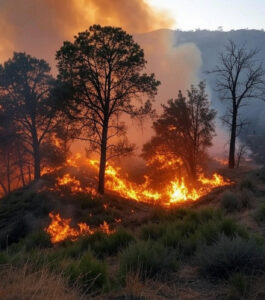 Just south of Apple Valley in San Bernardino County, on June 10, 2025, at approximately 2:33 PM, a wildfire—later known as the Ranch Fire—started close to the junction of Bowen Ranch Road and Coxey Truck Trail. Strong winds and low humidity contributed to the fire’s startling rapid spread, drawing the attention of local officials, citizens, and media outlets. A minor fire swiftly grew into a significant event that put the community’s readiness and firefighting resources to the test.
The Ranch Fire grew significantly in the few hours after it was started. By that evening, the fire had already consumed over 4,200 acres, according to local officials. The Ranch Fire eventually burned 4,293 acres before it was completely contained, according to CAL FIRE records. This fire was one of the biggest to start so early in the fire season in San Bernardino County, and it served as a sobering reminder that California is always at risk for wildfires.
Due to the size of the firefight, multiple agencies had to coordinate. CAL FIRE’s San Bernardino Unit, the San Bernardino County Fire Protection District, the Apple Valley Fire Protection District, the Bureau of Land Management’s California Desert District, and the San Bernardino County Sheriff’s Department were all part of the unified command.
By working together, they were able to protect neighboring communities and slow the spread of the fire. Nevertheless, in order to protect public safety, officials had to issue evacuation alerts due to the size of the fire. Residents south of Highway 18 between Milpas Drive and High Road were advised to evacuate by the Sheriff’s Department via Reverse 9-1-1 notifications. Large animals were sent to the Victorville Fairgrounds, and shelters for locals were promptly established at Sitting Bull Academy. Families and animals caught in the path of the fire were able to find safety thanks to these quick actions.
The firefighters dealt with difficult terrain and long hours to keep the fire at bay. In order to put out flare-ups in difficult-to-reach places, helicopters dropped water and fire retardant, providing vital air support. Thanks to higher humidity levels overnight, which helped slow the spread, firefighters were able to isolate important hotspots by the next morning. Firefighters achieved about 90 percent containment by June 16 after containment was at about 10 percent by June 11. As crews concentrated on putting out any remaining hot spots around the fire’s perimeter, the Ranch Fire quickly moved into patrol status.
Local and National Media Spotlight the Ranch Fire’s Rapid Spread
San Bernardino County was still affected by the Ranch Fire in spite of the well-coordinated firefight. Although there were no confirmed fatalities, hundreds of lives were disrupted by the forced evacuations, and at least one building was reported destroyed. Officials are still investigating the cause of the fire and have not yet established whether it was caused by natural causes, equipment failure, or human activity. The fire served as a reminder of how quickly life can change for locals who experienced the stress of evacuation orders and uncertainty about their homes.
The Ranch Fire’s media coverage contributed to the situation’s increased urgency. Under the headline “Fire season is here; Ranch Fire burns more than 4,000 acres,” the official CountyWire blog of the San Bernardino County government posted updates, highlighting the extent of the fire and the significance of being prepared for wildfires.
The blaze was also covered by national media, including the New York Post, which detailed how it broke out unexpectedly and prompted quick evacuations throughout the Apple Valley. These reports played a crucial role in informing the general public, especially regarding road closures, evacuation centers, and air quality problems. The Ranch Fire’s media coverage contributed to the situation’s increased urgency. Under the headline “Fire season is here; Ranch Fire burns more than 4,000 acres,” the official CountyWire blog of the San Bernardino County government posted updates, highlighting the extent of the fire and the significance of being prepared for wildfires.
The blaze was also covered by national media, including the New York Post, which detailed how it broke out unexpectedly and prompted quick evacuations throughout the Apple Valley. These reports played a crucial role in informing the general public, especially regarding road closures, evacuation centers, and air quality problems. Containment is not the end of recovery for those who are directly affected. Complex insurance disputes, land damage, lingering smoke damage, and scorched property are all possible outcomes of wildfires. In these situations, a San Bernardino County wildfire lawyer can be extremely helpful in guiding people and families through the claims process, obtaining financial compensation, and gaining access to resources for life reconstruction. A crucial but frequently disregarded component of disaster recovery is legal assistance, which makes sure that individuals impacted are not left to bear the costs alone.
Our Articles
© Copyright 2026 Fire Litigation. | All Rights Reserved.