
The Madre Fire: A Relentless Blaze Across San Luis Obispo’s Heartland
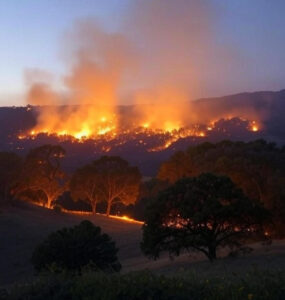 The Madre Fire was a wildfire that started along Highway 166 in a remote area close to New Cuyama in San Luis Obispo County on July 2, 2025, shortly after 1:00 p.m. A perfect storm of intense heat, low humidity, strong downslope winds, rough terrain, dry grasslands, and dense chaparral caused the fire to explode from its ignition point within hours. Residents were alarmed by the fire’s nearly 8,000-acre spread by the evening of its first day, which prompted several agencies to respond right away.
The fire was California’s largest wildfire of the year by early July 3, when it had spread to 35,000 acres. Its quick spread prompted evacuation orders in a number of locations, including isolated ranchlands and residential areas. In addition to the logistical difficulties caused by highway closures, including parts of Highway 166, residents were advised to evacuate right away. As the fire spread to more than 52,500 acres by July 4, more families were forced to evacuate, and the ability of nearby resources and emergency shelters was put to the test.
Madre Fire Expands to 80,000 Acres as Crews Battle Steep Terrain
Over the following few days, the Madre Fire kept expanding quickly. The fire had spread to about 80,000 acres by July 6–7, and containment was still less than 30%. Firefighting crews frequently used off-road vehicles and helicopters to reach firelines as they traversed steep ridges and canyons. During the height of the operation, over 600 people were sent in to put out the fire, including aircraft, engine crews, bulldozers, and hotshot teams. In order to stop the fire from spreading further into residential areas, fire management teams concentrated on establishing containment lines, carrying out backburns, and keeping an eye on wind shifts.
Much of San Luis Obispo and nearby Santa Barbara Counties were under evacuation orders and warnings. Some areas, including parts of the Carrizo Plain National Monument, were temporarily closed to the public, and more than 200 residents were forced to relocate. Businesses that depended on Highway 166 were impacted by the disruption to local traffic and the movement of goods caused by the closure of that route. Emergency services worked around the clock to help locals evacuate dangerous areas safely and to give people and their pets temporary housing.
Containment efforts started to show results by the middle of July. The fire was said to be 77–79% contained around July 12–13. Unfortunately, one structure was destroyed and another was damaged during the firefighting efforts, and two firefighters were hurt. The risks faced by first responders operating in intense heat, difficult terrain, and ever-changing fire conditions were highlighted by these incidents. With mop-up efforts in place to make sure no lingering hotspots would rekindle, containment had reached 97% by July 16. After burning 80,786 acres in total, full containment was declared around July 26.
Media coverage played a critical role in keeping residents informed. Daily updates on fire growth, containment levels, and evacuation zones were provided by local and national news outlets. Reporters emphasized the risks associated with smoke, poor air quality, and the possibility of swift fire spread. Information about road closures, firefighter operations, and tips for locals on how to safeguard their property and themselves were also included in the updates.
Rebuilding structures was only one aspect of the Madre Fire recovery. For impacted residents and landowners, filing insurance claims, evaluating damage, and navigating assistance programs can be extremely difficult. In order to put the pieces back together after such a tragic incident, a San Luis Obispo County fire lawyer can assist people with understanding their rights, filing claims, obtaining restoration funds, and handling liability issues.
Our Articles
© Copyright 2026 Fire Litigation. | All Rights Reserved.