
Eaton Fire January 7, 2027 Lawsuit Deadline
What Homeowners Without an Attorney Should Do Now
For many Eaton Fire survivors, January 7, 2027 may represent one of the most important legal deadlines since the fire.
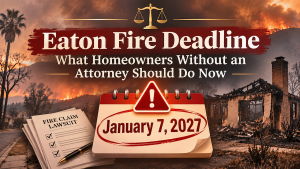 California generally gives people two years to file lawsuits involving personal injury, wrongful death, negligent or intentional infliction of emotional distress, and other injuries to a person. Because the Eaton Fire ignited on January 7, 2025, certain Eaton Fire claims against Southern California Edison could face a statute-of-limitations deadline as early as January 7, 2027.
California Courts identifies a two-year limitations period for these types of claims, and SCE itself has publicly warned Eaton Fire survivors about the January 2027 deadline. [1][2]
That deadline deserves particular attention from homeowners who have not yet retained an attorney.
Some survivors may assume that because they opened an insurance claim, submitted paperwork to Southern California Edison, or primarily lost a home rather than suffering a burn injury, they still have plenty of time. That assumption can create serious problems.
A homeowner may have several legally distinct claims arising from the same fire, and those claims do not necessarily share the same deadline. California generally provides three years for property-damage claims, potentially placing certain Eaton Fire property claims on a timeline extending to January 7, 2028. Personal injury, wrongful death and emotional-distress claims can face the shorter two-year period. [1]
Homeowners should not assume that the later property-damage deadline protects every part of their Eaton Fire claim.
Fire Litigation listed attorney Mary Alexander urges Eaton Fire survivors who remain unrepresented to review their circumstances now rather than waiting until the final weeks before January 7. Call (866) 312-5353 now to schedule a free consultation and discuss the details of your Eaton wildfire claim.
Why the January 7, 2027 Eaton Fire Deadline Matters
The Eaton Fire started on the evening of January 7, 2025, and devastated Altadena and surrounding communities.
In August 2026, the Los Angeles County Fire Department and CAL FIRE released the results of their 18-month origin-and-cause investigation. Investigators concluded that electrical arcing involving an out-of-service Southern California Edison transmission tower caused burning material to fall into dry vegetation below the tower and ignite the wildfire. The fire ultimately killed 19 people and destroyed or damaged more than 9,000 homes and businesses. [3]
CAL FIRE now officially lists the Eaton Fire’s cause as electrical. [4]
SCE has taken a somewhat more qualified position. In a recent SEC filing, the utility said that although its internal investigation remains ongoing, it believes it is likely that its equipment was associated with the ignition and that it knows of no evidence pointing to another possible ignition source. [5]
Thousands of Eaton Fire survivors have already pursued lawsuits or compensation claims. But a person who has not yet filed a lawsuit should not assume that existing litigation automatically preserves his or her individual rights.
A statute of limitations can eliminate an otherwise valid claim when the claimant waits too long to file. California Courts cautions that a defendant can ask a judge to dismiss a lawsuit filed after the applicable limitations period expires – even when the plaintiff otherwise has a strong case. [6]
The January 2027 Deadline Is Not Just About Physical Burns
One of the biggest misconceptions surrounding wildfire litigation is that a “personal injury” claim necessarily means a catastrophic physical injury. It does not.
California Courts specifically identifies wrongful death and intentional or negligent infliction of emotional distress, along with personal injury and other wrongful or negligent acts, among claims generally subject to the two-year limitations period under Code of Civil Procedure section 335.1. [1]
Eaton Fire survivors may therefore need to evaluate potential claims involving circumstances such as burns, smoke inhalation or other physical injuries; injuries sustained while evacuating; aggravation of respiratory or other medical problems; psychological or emotional injuries associated with the fire and evacuation; wrongful death; medical expenses; lost wages associated with an injury; pain and suffering; or other personal injuries caused by the fire.
Whether any particular survivor has a viable claim depends on the individual facts. The important point is that homeowners should identify all of their potential claims now, not simply focus on the value of the structure they lost.
Do Not Assume You Have Until January 2028 Because You Lost a Home
California generally provides a three-year period for claims involving damage to property. For Eaton Fire losses, SCE has publicly stated that certain property-damage lawsuits could face a deadline as early as January 7, 2028. [2]
That does not mean every Eaton Fire survivor can safely wait until 2028.
Consider a homeowner whose house burned down but who also suffered serious emotional distress, received treatment for smoke exposure or sustained an injury during evacuation.
The property claim and the personal-injury-related claims can involve different statutes of limitations.
A homeowner who waits until late 2027 because he or she believes “the wildfire deadline is three years” could discover that important two-year claims already expired.
Mary Alexander & Associates recommends treating January 7, 2027 as an urgent review date for any Eaton Fire survivor who experienced more than property damage alone.
What Eaton Fire Homeowners Without an Attorney Should Do Now
- Identify every loss the fire caused – not just the house. Make a separate list of property losses, physical injuries, emotional or psychological injuries, evacuation-related injuries, lost income, temporary housing costs, smoke and ash contamination, landscaping damage, vehicle losses and other expenses. Do not assume they all fall under the same statute of limitations.
- Have an attorney determine the applicable deadlines now. January 7, 2027 is an important potential deadline, but statutes of limitations depend on the facts. Wrongful-death claims, for example, generally run from the date of death rather than automatically from the date the fire started. Other tolling or accrual issues may also exist. California Courts specifically warns that statutes of limitations can be difficult to calculate. [1] Do not rely on an assumed exception without having someone analyze it.
- Get a complete copy of every applicable insurance policy. Do not rely solely on a declarations page. Gather homeowners, renters, automobile, umbrella and business policies that could potentially relate to the loss. Preserve insurer estimates, coverage letters, payment records and correspondence as well.
- Create a complete property-loss file. Keep photographs and video showing the property before and after the fire, contractor estimates, rebuilding bids, inventories of personal property, receipts, appraisal information, mortgage records and documentation of landscaping, vehicles, outbuildings and other property. Property claims may have a longer limitations period, but homeowners should begin documenting them now.
- Gather every medical record connected to the fire. Collect emergency-room records, urgent-care visits, hospitalization records, physician notes, prescriptions, respiratory treatment, physical therapy and follow-up care. If the fire worsened a preexisting condition, preserve records that show the person’s condition before and after January 7, 2025.
- Do not overlook mental-health treatment or emotional distress. Preserve records from therapists, psychologists, psychiatrists or other providers when relevant. Also document significant changes in sleep, anxiety, depression, panic, fear, concentration, work performance or daily activities following the fire. Emotional harm can present a different limitations issue from damage to the home itself. [1]
- Write down the evacuation story while details remain available. Record where each family member was when the fire started, when warnings arrived, when the family evacuated, the route taken, what the family saw, whether anyone suffered injury or smoke exposure and when the family learned the property had burned. Preserve text messages, emergency alerts, photographs and videos that can independently establish the timeline.
- Keep records of displacement and additional living expenses. Preserve hotel bills, leases, meals, transportation, storage, pet boarding, replacement clothing, temporary furniture, utility costs and other fire-related expenses. Do not assume the insurance company already possesses every receipt you may later need.
- Document lost income and business or rental losses separately. Self-employed homeowners, landlords and business owners should preserve tax returns, payroll information, rental records, canceled reservations, lost contracts and other evidence showing what they would likely have earned absent the fire.
- Families pursuing a wrongful-death claim should collect estate and dependency documents. Important records may include the death certificate, estate documents, funeral and burial expenses, medical expenses, financial-support records and evidence of the relationship between surviving family members and the person who died. Because the two-year wrongful-death period generally runs from the date of death, the deadline may not necessarily fall on January 7 in every case. [1]
- Determine whether you have submitted a claim through SCE’s compensation program. SCE has established a separate voluntary Wildfire Recovery Compensation Program. The deadline to submit a new claim to that program is November 30, 2026 – well before the potential January lawsuit deadline. SCE says owners, qualifying tenants, businesses, certain injured individuals and representatives of qualifying estates may participate. [7]
- Do not assume an SCE compensation claim extends the lawsuit deadline. SCE expressly treats its November 30 program deadline and the civil litigation statutes of limitations as separate deadlines. Filing a program claim, receiving an offer and reviewing that offer do not themselves waive the right to litigate. Survivors should nevertheless continue tracking the applicable lawsuit deadline while SCE evaluates a claim. [2]
- Do not sign a settlement release without understanding what it ends. SCE states that claimants retain their legal rights until they accept an offer and sign a settlement agreement and full release. Once accepted, the release waives past and future Eaton Fire claims against SCE and related entities covered by the agreement. [8] A homeowner should understand the value of unresolved property, injury, emotional-distress and other claims before signing away those rights.
- Do not wait until January to begin looking for a lawyer. Reviewing insurance records, medical evidence, ownership documents, potential plaintiffs and causes of action takes time. So does preparing and filing a lawsuit. A January 7 deadline does not mean January 7 is the appropriate day to start investigating the case.
SCE’s November 30 Compensation Deadline Is a Separate Decision
For homeowners without attorneys, the approaching November 30, 2026 deadline creates another decision that deserves immediate attention.
SCE says nearly 17,000 individuals, trusts and legal entities had participated in its Wildfire Recovery Compensation Program by October 30, 2026. The company had extended approximately $1.1 billion in offers and paid more than $625 million. [9]
The program is voluntary.
SCE says submitting a claim, receiving an offer and evaluating the offer do not waive a claimant’s legal rights. A claimant can decline an offer. Acceptance, however, requires a settlement agreement and release. [8]
The program also applies eligibility rules that do not necessarily mirror the rules governing a civil lawsuit.
For example, SCE’s program generally defines eligible physical-injury claims as injuries sustained within the eligibility area where the claimant received specified medical treatment between January 7 and January 15, 2025. Its fatality provisions also impose program-specific requirements. [8]
That distinction matters. A homeowner should not assume that SCE’s program eligibility rules define the full scope of legal rights available in court.
Likewise, someone who receives an SCE offer should consider the entire claim – not simply the amount immediately offered – before deciding whether to execute a release.
The Eaton Fire Cause Investigation Has Changed the Legal Landscape
The January 2027 deadline approaches after investigators reached a significant conclusion concerning the fire’s origin.
On August 4, 2026, the Los Angeles County Fire Department announced that its joint investigation with CAL FIRE determined that electrical arcing on an out-of-service SCE transmission tower caused the Eaton Fire. Investigators found that burning material fell into dry vegetation beneath the tower, igniting the surrounding fuel. [3]
The Los Angeles Times reported that investigators identified two electrical arcing events and that the vegetation beneath the tower ignited approximately 12 seconds later. [10]
Reuters likewise reported that investigators concluded SCE equipment caused the ignition. [11]
Those findings do not eliminate the need for individual homeowners to prove their own damages.
A utility-related wildfire case can involve extensive questions about home value, rebuilding expenses, personal property, insurance offsets, physical injuries, emotional harm, loss of income, displacement and other damages. That makes individualized documentation especially important.
What If You Already Settled Part of Your Eaton Fire Insurance Claim?
An insurance payment does not necessarily mean that every Eaton Fire claim has ended. Homeowners insurance and a claim against a responsible third party involve different legal relationships.
Insurance may pay some rebuilding costs, personal property, additional living expenses and other covered losses. Depending on the circumstances, a third-party wildfire claim may involve losses insurance did not fully compensate.
Examples can include deductibles, underinsured losses, certain non-economic damages and other amounts that depend on the facts and legal claims involved.
Homeowners should preserve all insurer payment records and identify precisely what each payment covered.
They should also disclose insurance information to their attorney because insurers can have reimbursement or subrogation rights that affect the ultimate recovery.
What If You Never Went to the Hospital?
Do not automatically conclude that you have no injury-related claim. SCE’s voluntary compensation program uses specific medical-treatment requirements for its injury component. Civil litigation operates under a different legal framework. [8]
Whether someone has a viable lawsuit for smoke exposure, evacuation injuries, emotional distress or another injury requires an individual legal analysis.
The safest approach is to have the circumstances reviewed before the limitations period expires rather than deciding independently that an injury “does not count.”
What If You Think the Deadline Has Already Passed?
Do not automatically abandon the claim. California recognizes certain circumstances that can affect when a statute of limitations begins to run or whether it becomes tolled for a period of time. California Courts expressly cautions that limitations periods are fact-specific and can be difficult to calculate. [1]
But survivors should not rely on a possible exception as a reason to wait.
The closer a case gets to January 7, 2027, the less time an attorney has to investigate those issues and take whatever action may remain available.
Mary Alexander & Associates Can Review Eaton Fire Claims Before the Deadline
For more than two decades, Mary Alexander & Associates has represented people whose lives changed because of catastrophic injuries, wrongful deaths, fires and the conduct of powerful corporations and institutions.
Mary Alexander brings decades of trial experience to cases involving complex causation and significant personal loss. Her work includes fire litigation as well as catastrophic personal injury and wrongful-death matters.
For Eaton Fire survivors, the immediate concern now is time.
A homeowner who has not retained an attorney should determine: What claims do I actually have? Which deadline applies to each one? What has insurance already paid? What damages remain unpaid? Should I participate in SCE’s compensation program? If I have an offer, what rights would I release by accepting it? And does a lawsuit need to be filed before January 7, 2027?
Those questions deserve answers before the statute of limitations becomes the issue that decides the case.
The January 7, 2027 deadline may not apply identically to every Eaton Fire survivor. But for many personal injury, emotional-distress and wrongful-death claims, waiting beyond that date could jeopardize the right to seek recovery.
If you suffered losses in the Eaton Fire and have not yet retained an attorney, contact Mary Alexander & Associates now to have your potential claims and filing deadlines reviewed before January 7, 2027.
Important Disclaimer
This article provides general information and does not establish the filing deadline for any individual claim. Statutes of limitations depend on the facts, type of claim and potential exceptions. An attorney should evaluate the deadline that applies to a particular Eaton Fire survivor.
Sources and References
The following non-law-firm sources support the legal deadlines, fire-cause findings, and SCE compensation-program information discussed above. Links are clickable.
[1] California Courts Statutes of limitations for civil cases – https://www.selfhelp.courts.ca.gov/civil-lawsuit/statute-limitations
[2] Southern California Edison Key deadlines approaching for Eaton Fire recovery compensation – https://newsroom.edison.com/releases/key-deadlines-approaching-for-eaton-fire-recovery-compensation
[3] Los Angeles County / CAL FIRE Eaton Fire origin-and-cause investigation announcement – https://content.govdelivery.com/accounts/CALACOUNTY/bulletins/423922d
[4] CAL FIRE Eaton Fire incident page – https://www.fire.ca.gov/incidents/2025/1/7/eaton-fire
[5] U.S. Securities and Exchange Commission Edison International / SCE filing discussing Eaton Fire ignition – https://www.sec.gov/Archives/edgar/data/92103/000082705226000073/eix-20260930.htm
[6] California Courts Before you sue: statute of limitations warning – https://www.selfhelp.courts.ca.gov/civil-lawsuit/before-sue
[7] Southern California Edison Wildfire Recovery Compensation Program – https://energized.edison.com/wildfire-recovery-compensation-program
[8] Southern California Edison Wildfire Recovery Compensation Program FAQ – https://energized.edison.com/wildfire-recovery-compensation-program/faq
[9] Southern California Edison Record pace of Eaton Fire claims ahead of Nov. 30 deadline – https://newsroom.edison.com/releases/record-pace-of-eaton-fire-claims-for-sce-program-continues-ahead-of-nov-30-deadline
[10] Los Angeles Times Investigators identify Edison tower as Eaton Fire cause – https://www.latimes.com/california/story/2026-08-04/edison-tower-eaton-fire-cause
[11] Reuters Southern California Edison equipment blamed in Eaton Fire – https://www.reuters.com/legal/litigation/southern-california-edison-equipment-blamed-2025-eaton-fire-la-local-media-says-2026-08-04/
Our Articles
© Copyright 2026 Fire Litigation. | All Rights Reserved.