
Ross Fire Lawsuit Investigation
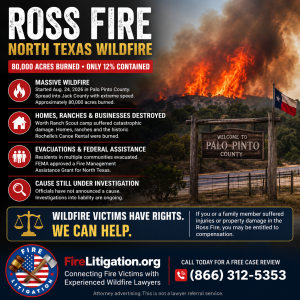 Ross Fire is a massive wildfire burning west of Fort Worth has swept across tens of thousands of acres, destroyed homes and businesses, threatened historic properties and forced residents in multiple North Texas communities to evacuate. The Ross fire is now the second largest wildfire ever to be recorded in North Texas.
The Ross Fire, which started Monday, August 24, 2026, in Palo Pinto County, expanded with extraordinary speed before moving north into neighboring Jack County. By Wednesday night, the fire had burned approximately 80,000 acres and remained only 12% contained, according to reporting citing the Texas A&M Forest Service. (CBS Texas)
The fire has already caused significant property damage. Buildings at the historic Worth Ranch Scout camp suffered catastrophic damage, homes and ranch structures have burned, and a longtime family-owned canoe rental business along the Brazos River was devastated. (CBS Texas)
Contact a Texas wildfire attorney listed on FireLitigation.com for more information regarding a lawsuit as investigations as to causation and liability continue. If you or a family member suffered serious injuries or your home, ranch, business or other property suffered damage in the Ross Fire, call a Ross Fire attorney featured on Fire Litigation at (866) 312-5353 to discuss your situation and learn about your potential legal options.
For Texas property owners, ranchers and business operators affected by the Ross Fire, the immediate priority remains personal safety. But another critical issue will become increasingly important as the emergency stabilizes:
What caused Ross Fire, and could a person, company, contractor, utility or other party ultimately bear responsibility for the damage? As of Monday 8/31/26, Ross Fire reportedly began as a grass fire west of Palo Pinto near Highway 180. Officials have not identified a source of ignition and Ross Fire remains under investigation. (The Dallas Morning News – subscription required).
Ross Fire Explodes Across Palo Pinto and Jack Counties
The Ross Fire began shortly before 1:30 p.m. Monday near Ross in Palo Pinto County, approximately 60 miles west of Fort Worth.
Officials initially estimated the fire at only about 25 acres. Within hours, however, extreme heat, dry vegetation and strong winds helped push the flames across thousands of acres.
By Tuesday morning, the blaze had reached roughly 50,000 acres. By Wednesday, officials estimated it at approximately 80,000 acres. (CBS Texas)
The fire crossed from Palo Pinto County into Jack County and threatened communities around Palo Pinto, Graford, Bryson, Possum Kingdom and the Brazos River.
Firefighters faced rapidly shifting winds and dangerous fire behavior as they attempted to build containment lines and protect structures. Texas A&M Forest Service personnel, local and volunteer fire departments, Texas Intrastate Fire Mutual Aid System crews and aviation resources joined the response. (Spectrum News)
Governor Greg Abbott announced that FEMA approved a Fire Management Assistance Grant for the Ross Fire after the state reported that the wildfire threatened homes, damaged property and infrastructure and prompted evacuations in both Palo Pinto and Jack counties. (Office of the Texas Governor)
Ross Fire Destroys Homes, Ranches and Historic Texas Properties
The Ross Fire has demonstrated how quickly a rural Texas wildfire can destroy property that families and organizations spent generations building.
One of the most significant losses occurred at Worth Ranch, a historic Scouting America camp in Palo Pinto County that has operated for nearly a century.
The Longhorn Council of Scouting America reported catastrophic damage to numerous structures at the property. No Scouts, campers or guests were at the camp when the fire reached it, and personnel evacuated safely. (CBS Texas)
Elsewhere in Palo Pinto County, ranchers raced to move cattle and other livestock as flames approached homes and agricultural properties.
The fire also devastated Rochelle’s Canoe Rental, a family business located along the Brazos River near Graford.
The Rochelle family has owned the surrounding land since 1928, and the canoe rental business opened in 1969. FOX 4 reported that the Ross Fire destroyed shops, sheds, equipment and a house associated with the property. The business owners said essentially nothing from the operation remained salvageable. (FOX 4)
FOX 4 also reported that Rochelle’s did not carry business insurance, leaving significant uncertainty about the company’s future. (FOX 4)
Losses like these demonstrate why determining a wildfire’s cause can become so important.
Insurance may provide one avenue of recovery for some victims. But when investigators determine that negligent conduct caused a wildfire, the responsible person or company may potentially face claims for damage that insurance does not fully cover.
What Caused the Ross Fire?
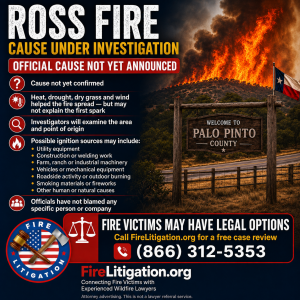 As of 8/31/26, it appears as though the Ross Fire may have started as a grass fire, authorities have not yet confirmed that, nor has there been a source of ignition identified. That distinction is important.
Extreme heat, drought conditions, dry grass and high winds can cause an ignition to spread extraordinarily quickly, but dangerous weather conditions do not necessarily explain what created the initial spark.
Investigators will likely focus on locating the fire’s area and point of origin before evaluating possible ignition sources.
- Electrical lines, transformers and other utility equipment;
- Construction, welding, grinding or similar work;
- Farm, ranch or industrial machinery;
- Vehicles or mechanical equipment;
- Roadside activity;
- Outdoor burning;
- Smoking materials;
- Fireworks or other open-flame activity; and
- Other potential human or natural ignition sources.
Officials have not publicly attributed the Ross Fire to any of these causes.
Texas residents should therefore avoid assuming that any particular company, utility or individual started the fire until investigators complete their work.
Could the Ross Fire Lead to Texas Wildfire Lawsuits?
Potential lawsuits will depend almost entirely on what the origin-and-cause investigation discovers. Not every wildfire creates a viable lawsuit.
If the evidence shows that an unavoidable natural event caused the Ross Fire, there may be no third party from whom victims can seek compensation.
If investigators instead determine that a person or company negligently caused the ignition, affected property owners could potentially pursue claims against the responsible party.
For example, liability issues can arise when evidence shows that a party failed to properly maintain dangerous equipment, performed work that produced sparks during extreme fire conditions, allowed an unsafe activity to ignite surrounding vegetation or otherwise failed to exercise reasonable care.
Texas fire attorneys investigating a major wildfire may examine far more than the government’s final cause determination.
Evidence can include photographs and video, witness statements, weather records, maintenance records, dispatch information, surveillance footage, electronic records and physical evidence recovered from the suspected origin area.
The specific facts surrounding the Ross Fire will determine whether those types of claims exist.
Texas Ranchers Could Face Particularly Significant Ross Fire Losses
Unlike wildfires that primarily burn through densely populated neighborhoods, the Ross Fire has traveled through a large area of Texas ranchland.
That creates a different category of potential losses.
Ranchers may suffer damage to:
- Cattle and other livestock;
- Fencing;
- Barns, sheds and outbuildings;
- Tractors and agricultural equipment;
- Feed and hay;
- Wells and water infrastructure;
- Grazing land;
- Timber and vegetation;
- Vehicles;
- Homes located on ranch property; and
- Income-producing agricultural operations.
Even where livestock survive, ranchers can incur substantial expenses moving animals, securing temporary pasture, treating injured animals, replacing fencing and restoring damaged land.
Residents should photograph these losses and maintain detailed records of emergency expenditures whenever conditions make it safe to do so.
Ross Fire Business Losses May Extend Far Beyond Burned Buildings
The destruction of Rochelle’s Canoe Rental provides an especially stark example of how a wildfire can affect a Texas business. The physical buildings and equipment represent only part of the potential financial loss.
A business forced to close after a fire may also lose future revenue, inventory, equipment, customer bookings and the ability to operate during rebuilding.
Other businesses may suffer losses even when flames never reach their property. Road closures, evacuation orders, smoke, power interruptions and restricted access can disrupt businesses across the surrounding area. Whether insurance covers those losses depends on the individual policy and circumstances.
If investigators identify a responsible third party, business owners may also need to determine whether losses not reimbursed by insurance can form part of a separate claim.
Texas Homeowners Should Review Their Fire Insurance Coverage
Property owners affected by the Ross Fire should contact their insurers promptly and request copies of their complete policies.
Depending on the coverage purchased, insurance may potentially apply to:
- Structural fire damage;
- Personal property;
- Smoke and ash damage;
- Additional living expenses;
- Debris removal;
- Temporary relocation;
- Vehicles and equipment;
- Business property;
- Lost income or business interruption; and
- Certain cleanup expenses.
Disputes can arise over the value of destroyed property, replacement costs, depreciation, smoke contamination and whether a structure can safely be repaired.
Residents should consider documenting damaged property before significant cleanup or demolition occurs.
They should also maintain copies of estimates, receipts, photographs, videos and all communications with insurance representatives.
Texans Should Preserve Evidence From the Ross Fire Now
Some of the most useful evidence in a wildfire investigation can disappear quickly.
Residents who photographed or recorded the Ross Fire during its earliest stages should preserve the original digital files.
That includes photographs or videos showing:
- The first smoke or flames;
- The direction from which smoke appeared;
- Roads near the suspected origin;
- Vehicles or machinery in the area;
- Utility poles or electrical equipment;
- Construction or maintenance activity; or
- Any unusual event immediately before the fire became visible.
People should preserve the original files rather than retaining only copies uploaded to social media because original photographs and videos may contain metadata concerning when and where they were recorded.
Property owners should similarly document damage before debris removal whenever officials determine that returning to the property is safe.
Texas Fire Attorneys Monitoring Ross Fire Cause
The Ross Fire remains an active wildfire, and conditions can change rapidly.
As of Wednesday night, the blaze had burned approximately 80,000 acres across Palo Pinto and Jack counties and remained 12% contained. Officials had lifted some evacuation orders as conditions improved, but residents were warned to remain alert while firefighters continued working to contain the fire. (CBS Texas)
For families who lost homes, ranchers who lost agricultural property and businesses facing potentially devastating losses, the investigation into the Ross Fire’s cause could become critically important.
Texas fire attorneys will continue monitoring the Ross Fire investigation, including any findings concerning the area of origin, ignition source and whether negligent conduct contributed to the disaster.
Until investigators release their findings, no one should assume that a particular person, company or utility caused the Ross Fire.
But Texas property owners who suffered substantial losses should preserve evidence now, carefully document their damages and understand that an insurance claim and a potential claim against a responsible third party are two separate issues.
If your home, ranch, business or other property suffered damage in the Ross Fire, call Fire Litigation at (866) 312-5353 to discuss your situation and learn about your potential legal options.
Our Articles
© Copyright 2026 Fire Litigation. | All Rights Reserved.