
Hawk Fire Lawsuit Investigation
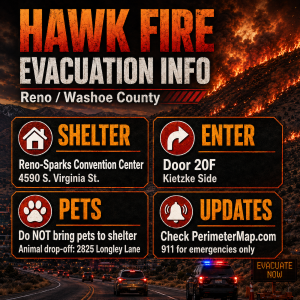 A rapidly expanding wildfire on the outskirts of Reno has forced thousands of residents to evacuate, threatened neighborhoods across Washoe County and raised concerns about what caused the blaze and whether any person, company or utility could ultimately face responsibility for the resulting losses.
The Hawk Fire, which started Saturday, August 22, 2026, near Somersett and Peavine northwest of Reno, exploded to more than 15,000 acres as of Monday August 24, 2026. Strong winds, extremely dry vegetation and low humidity pushed the fire toward populated portions of the Reno area, prompting widespread evacuation orders and a state of emergency in Washoe County.
Officials reported the Hawk Fire at 0% containment and The Guardian has quoted Truckee Meadows battalion chief Shane Akerson as stating the fire was “human-caused. This can mean that the fire was caused by arson or negligence.
Nearly 14,000 homes were ordered evacuated as the Hawk Fire advanced toward Reno, with the mandatory evacuation zone reportedly reaching the edge of the University of Nevada, Reno campus. (Source: Associated Press)
For Reno residents facing evacuation, property damage or prolonged displacement, the immediate priority remains safety. But as firefighters work to control the blaze, investigators will also begin answering another critical question: What caused the Hawk Fire?
That answer could eventually determine whether Reno-area property owners have claims beyond their homeowners or business insurance policies.
If your Reno or Washoe County home, business or property suffers damage from the Hawk Fire, call 866 312-5353 to discuss your situation and learn about your potential options. Learn more about wildfire lawyers in Nevada.
Hawk Fire Evacuation Instructions
Hawk Fire evacuees can go to Reno-Sparks Convention Center, Hall 4, at 4590 S. Virginia St., Reno. Enter through Door 20F on the Kietzke Lane side. Washoe County Human Services, Allied Security and the American Red Cross are assisting evacuees there.
Do not bring pets to the evacuation center. Take pets instead to Washoe County Regional Animal Services, 2825 Longley Lane.
Residents should not call 911 for evacuation information; 911 should be reserved for emergencies (information per Washoe Regional Emergency Information Center).

Hawk Fire in Reno and Washoe County Communities
The Hawk Fire developed quickly in the hills northwest of Reno near Somersett, Peavine and Verdi, an area where residential development meets dry wildland vegetation.
Wind rapidly pushed the blaze across thousands of acres and toward more densely populated sections of the Reno area. Truckee Meadows Fire & Rescue officials described conditions as highly dynamic, with gusty winds complicating firefighting efforts and pushing flames toward populated areas. (Source: Reuters)
Evacuation orders expanded throughout Saturday and into Sunday.
Residents in Verdi, Somersett and portions of northwest Reno received evacuation orders, while additional communities remained under warnings as officials monitored changing fire behavior. The rapidly moving evacuation area ultimately approached the University of Nevada, Reno. (Source: Associated Press)
Nevada Governor Joe Lombardo declared a state of emergency for Washoe County and activated the Nevada National Guard. The Guard deployed helicopter crews to assist aerial firefighting operations and personnel to help law enforcement protect evacuated neighborhoods. More than 400 personnel from multiple agencies were reported to be involved in the firefighting effort. (Source: Associated Press)
An evacuation center was established at the Reno-Sparks Convention Center.
Hawk Fire Disrupts Roads, Airports and Power Around Reno
The Hawk Fire has also affected major infrastructure throughout the Reno region.
Authorities closed portions of U.S. Route 395 as flames and smoke moved through northern Reno. The Reno-Stead Airport restricted operations for firefighting aircraft, while Reno-Tahoe International Airport remained operational as officials continued monitoring conditions. (Source: Associated Press)
Thousands of homes and businesses also lost power as the fire threatened electrical infrastructure.
The disruption extended west into Truckee and the North Lake Tahoe region, where utilities de-energized transmission equipment because of the danger posed by the advancing fire. (Source: 2 News Nevada)
Those outages are important to distinguish from the cause investigation.
There is currently no determination that electrical equipment or a utility started the Hawk Fire. Available reporting indicates that at least some transmission lines were shut down because the existing wildfire threatened utility infrastructure.
As of August 23, the Hawk Fire’s cause remained under investigation. (Source: Loving Reno)
What Caused the Hawk Fire Near Reno?
Determining where and how the Hawk Fire started will require an extensive investigation; NBC4 has reported the fire as “human-caused” but details are spares at the moment.
Fire investigators are working to locate the area of origin before examining physical evidence for possible ignition sources. They may evaluate electrical equipment, vehicles, construction activity, machinery, discarded smoking materials, outdoor fires and other potential human causes.
Investigators can also examine photographs, surveillance footage, witness accounts, weather data and utility records to reconstruct what occurred immediately before the fire began.
For Reno residents, that investigation could become particularly important if the Hawk Fire damages homes, businesses or other property.
A wildfire does not automatically create a lawsuit. But if investigators determine that negligent conduct caused or contributed to the Hawk Fire, injured residents and property owners may potentially have legal claims against the responsible party.
When Can a Reno Wildfire Lead to a Lawsuit?
Wildfires can begin naturally, accidentally or because someone failed to exercise reasonable care.
Depending on the evidence ultimately uncovered in the Hawk Fire investigation, potential sources of liability could include:
- Utility or electrical equipment. Failed power lines, transformers, poles or other electrical infrastructure can ignite surrounding vegetation in some wildfire cases. At this time, authorities have not determined that utility equipment caused the Hawk Fire.
- Construction or commercial activity. Welding, grinding, cutting and other equipment can produce sparks capable of igniting dry vegetation.
- Vehicles and machinery. Mechanical failures, hot exhaust components, sparks or dragging equipment can ignite roadside or wildland vegetation.
- Negligent property activity. Businesses, contractors or property owners may potentially face liability when unsafe conduct starts a fire that spreads beyond the property.
- Other human-caused ignition sources. Investigators may evaluate campfires, smoking materials and other activity when determining how a wildfire began.
The specific evidence – not speculation during the emergency – will determine whether any of these factors played a role in the Hawk Fire.
Reno Hawk Fire Victims May Face Significant Losses
Wildfire damage can extend far beyond the destruction of a building. Even homeowners whose properties survive direct flames can face smoke damage, ash contamination, landscaping losses, spoiled food, temporary relocation costs and other expenses associated with evacuation.
Businesses may experience interruption losses when employees cannot reach facilities, roads close, electricity fails or mandatory evacuation orders prevent normal operations.
If investigators eventually identify a responsible party, potential wildfire claims could include compensation for:
- Homes and other structures damaged or destroyed by fire;
- Personal property losses;
- Smoke and ash damage;
- Vehicles and landscaping;
- Temporary housing and evacuation expenses;
- Business interruption and lost income;
- Cleanup and remediation expenses;
- Personal injuries; and
- Other documented economic losses.
The availability and value of any claim will depend on the circumstances of the individual loss and the evidence concerning the fire’s cause.
Insurance Claims Could Become Important for Reno Residents
Residents do not need to wait for investigators to determine the Hawk Fire’s cause before contacting their insurance companies.
Homeowners and businesses affected by the fire may have coverage for fire damage, smoke damage, additional living expenses, lost inventory, business interruption or other losses depending on the terms of their policies.
Policyholders should carefully document their losses.
When it is safe to return, residents should consider photographing and recording affected property before cleanup or repairs begin. They should preserve receipts for hotels, meals, transportation and other evacuation-related expenses and retain copies of all communications with their insurers.
Property owners should also request and preserve a complete copy of their insurance policy.
Insurance disputes can arise over replacement costs, depreciation, repair estimates, smoke contamination, additional living expenses and whether a property suffered a covered loss.
Reno Residents Should Preserve Hawk Fire Evidence
Residents may also possess evidence relevant to determining what occurred. Anyone who took photographs or videos around Somersett, Peavine, Verdi or other areas near the fire’s early stages should preserve the original files.
Images showing the first visible smoke, flames, vehicles, equipment, power infrastructure or other activity near the suspected origin area could become important as investigators reconstruct the fire’s timeline.
Residents should avoid deleting original photographs or videos, even after posting copies to social media. Original digital files can contain information concerning when and where an image was recorded.
Property owners should also document fire damage before significant cleanup whenever safely possible.
Reno Fire Attorneys Monitoring Hawk Fire Investigation
The Hawk Fire remains an active and rapidly changing emergency. Weather conditions, evacuation orders, road closures and containment levels can change with little warning. Reno and Washoe County residents should continue following official emergency alerts and evacuate immediately when directed by local authorities.
At the same time, the eventual investigation into the Hawk Fire’s origin could have significant consequences for residents whose homes, businesses and property suffer losses.
Reno wildfire attorneys will closely monitor the investigation into the Hawk Fire, including evidence concerning where the fire started, possible ignition sources, utility infrastructure and whether negligence by any person or company contributed to the disaster.
Until investigators announce their findings, residents should avoid assuming that any specific party caused the fire.
But those who suffer substantial losses should preserve evidence, document their damages and understand the difference between an insurance claim and a potential claim against the person or entity responsible for starting a wildfire.
If your Reno or Washoe County home, business or property suffers damage from the Hawk Fire, call 866 312-5353 to discuss your situation and learn about your potential options.
*Photo credit: All photos and graphics created using ChatGPT.
Our Articles
© Copyright 2026 Fire Litigation. | All Rights Reserved.